

Personal Yummy #92
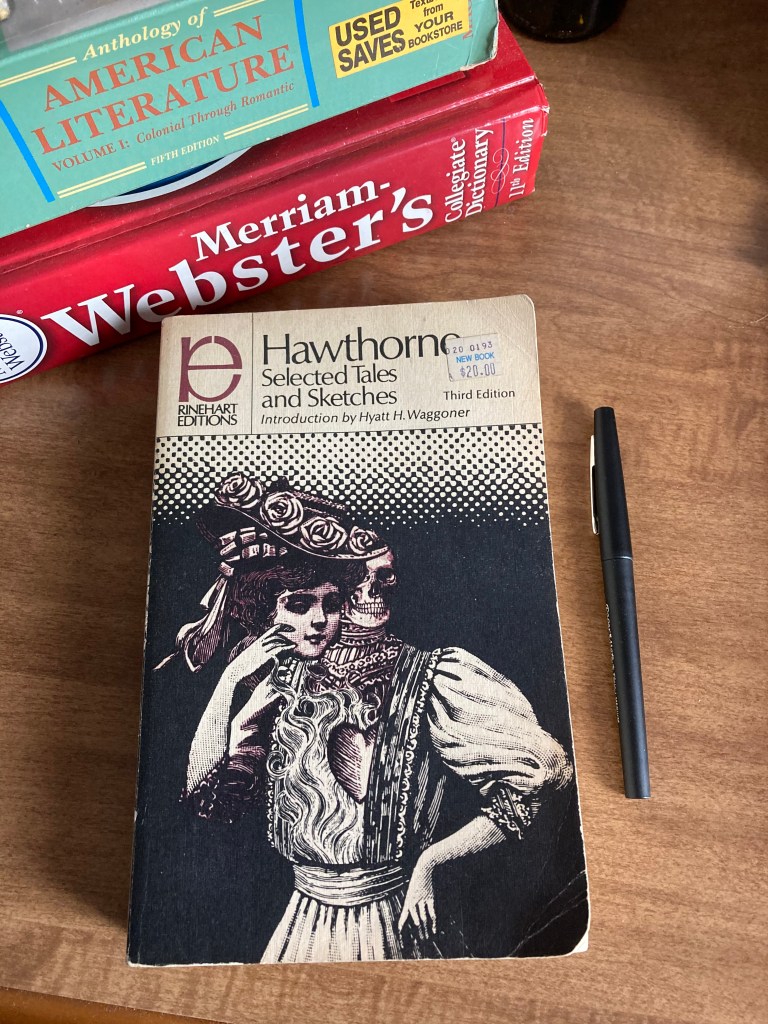
If you are a lover of Nathaniel Hawthorne (and even if you are not), perhaps you will enjoy my college-age perspectives on “Rappaccini’s Daughter,” a complex and symbolic story.
Continued from an earlier post, below is Part 2 of the Introduction.
However, if you missed Part 1, enjoy it via the following link: Introduction (Part 1)
******
INTRODUCTION
(Part 2)
In determining at what part of the twentieth century I should begin doing my research, I consulted mainly the Modern Language Association Bibliography and the Humanities Index and constructed a chart listing the number of critical essays written about “Rappaccini’s Daughter” from year to year.
I was provided with the following information:
Whereas from 1900 to 1980 approximately 10 to 15 articles were written about “Rappaccini’s Daughter,” from 1980 to the present (April 1995) approximately 40 critical essays had been produced, of which 27 were written during the 1980s.
Of course, this was quite intriguing to me and incited me to ask various questions, the foremost being, “What is it about the culture of this modern era and the attitudes of the individuals writing in this era that attract them so widely to a story such as ‘Rappaccini’s Daughter’?”
Thus, having completed this survey, I decided to “mold,” once again, the focus of my tutorial while keeping the same idea in mind. I resolved to study the critical interpretations written during the 1980s—and particularly during the years 1982, 1984, and 1986—because the most essays were written during these years.
But this is not the only reason I decided to focus on the 1980s.
First of all, the 1980s constitute the time in which I grew up, and I wanted to study this decade because I am familiar with it and desired to gain some additional insight into it.
Secondly, a tutorial focused on the attitudes and culture of the past decade would be interesting, helpful, intriguing, and—most of all—germane to readers of the present decade (the 1990s). Possibly, through reading my tutorial, readers will be able to better apprehend why they behave the way they do in the present time, or why they have a particular reaction to something they read, because they will be more aware of the cultural forces that have acted upon them, and that continue to do so today.
Therefore, when I began my research, the question I was asking and confronting was whether I would discover similarities and a definite pattern of criticism throughout the 1980s, and, if I did, what events and attitudes in the culture caused this to be so. I conjectured that I would find similarities in the interpretations, and not only among the individual years themselves, but consistently from year to year.
And that is exactly what I found.
There were many different avenues I could have taken, but because I have always been interested in theme, I decided to attend to the three main themes upon which the critics concentrated their discourse.
My tutorial is structured in the following manner:
The first three chapters are summaries of the critical discourse written about “Rappaccini’s Daughter” in the years 1982, 1984, and 1986.
The fourth and final chapter is my analysis of what I have discovered through the research, and my conjectures regarding the explanations and basis behind what I have found.
******
Thank you for reading Part 2 of the Introduction. I hope that it further stimulated your curiosity.
Stay tuned for Part 1 of Chapter I in a later post.
******
BIBLIOGRAPHY
Primary Source: Waggoner, Hyatt H. Hawthorne: Selected Tales and Sketches. 3rd ed. Orlando: Holt, 1970.
 personalyummy.com
One thought on “Conceptions of Hawthorne’s “Rappaccini’s Daughter”: Part 2 of the Introduction”